Kits
NanoAmp™
amplicon kits
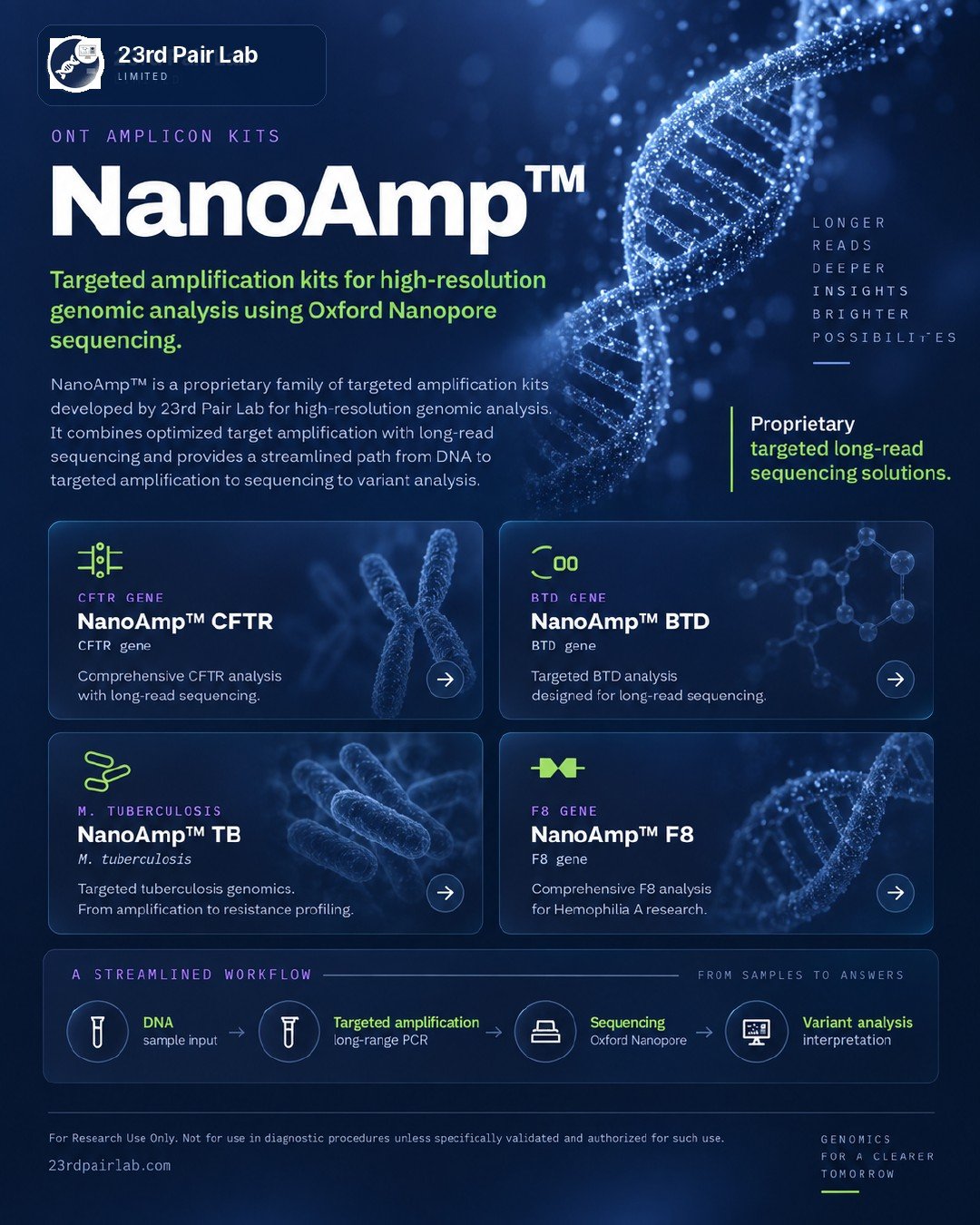
NanoAmp™ is a proprietary family of targeted amplification solutions developed by 23rd Pair Lab for high-resolution genomic analysis using Oxford Nanopore sequencing. One platform, with a workflow designed around each target. For research use only.
The technology
One platform.
Target-specific workflows.
NanoAmp™ combines optimised target amplification with long-read sequencing, with assay designs tailored to the biological and genomic characteristics of each target. The stages below are the shape every assay takes; the amplification strategy and the analysis at the end are specific to each one.
DNA
Sample DNA in, with assay design chosen for the target.
Targeted amplification
Long-range PCR focused on the genomic region of interest.
Sequencing
Oxford Nanopore long-read sequencing, multiplex-ready.
Variant analysis
Variant calling and interpretation, with genomic context retained.
CFTR gene
NanoAmp™ CFTR
Comprehensive CFTR analysis with long-read sequencing.
A targeted amplification kit for comprehensive analysis of the CFTR gene using Oxford Nanopore sequencing. The assay is designed around long-range amplification of the CFTR genomic region, sequencing across coding and clinically relevant non-coding regions while retaining long-read information for variant phasing.
Applications Cystic fibrosis research · CFTR variant characterization · Variant phasing and haplotype analysis
- Long-range amplicon design
- Detection of SNVs and small indels
- Analysis of clinically relevant intronic regions
- Long-read variant phasing
CFTR targeted workflow
From sample to CFTR insight
- 1 DNA sample patient or research DNA
- 2 Long-range CFTR amplification targeted CFTR region coverage
- 3 Nanopore sequencing long-read Oxford Nanopore
- 4 Variant phasing & interpretation SNVs, indels, intronic regions
CFTR locus — 7q31.2, approximately 250 kb, 27 coding exons plus clinically relevant intronic regions.
BTD gene
NanoAmp™ BTD
Targeted BTD analysis designed for long-read sequencing.
A proprietary targeted amplification kit for analysis of the BTD gene, supporting molecular research into biotinidase deficiency. The assay uses a multi-amplicon long-range strategy designed to capture the BTD genomic region in sequencing-ready fragments while maintaining long-read compatibility.
Applications Biotinidase deficiency research · BTD variant characterization · Targeted sequencing
- Multi-amplicon long-range design
- Multiple amplicons optimized for gene coverage
- SNV and indel detection
- Streamlined PCR-to-sequencing workflow
BTD assay workflow
Targeted long-read characterization
- 1 DNA sample research sample input
- 2 Multi-amplicon BTD PCR amplicons optimized for coverage
- 3 Long-read sequencing Oxford Nanopore workflow
- 4 BTD variant characterization SNVs, indels, gene-level analysis
M. tuberculosis
NanoAmp™ TB
Targeted tuberculosis genomics. From amplification to resistance profiling.
A targeted amplification solution for genomic analysis of Mycobacterium tuberculosis. The assay enriches clinically relevant genomic regions associated with drug resistance, strain characterization and molecular epidemiology — focused sequencing without requiring whole-genome sequencing for every application.
Applications MTB drug-resistance research · Strain and lineage characterization · Molecular epidemiology
- Drug-resistance associated target analysis
- Multiplex amplification
- Native or PCR-based barcoding compatibility
- Scalable sample processing
TB resistance profiling workflow
Focused MTB analysis
- 1 DNA sample MTB sample input
- 2 Multiplex MTB amplification resistance-associated targets
- 3 Nanopore sequencing barcode-ready long reads
- 4 Resistance & lineage analysis mutations, strain, epidemiology
F8 gene
NanoAmp™ F8
Comprehensive F8 analysis for Hemophilia A research.
A long-range targeted amplification kit for comprehensive molecular analysis of the F8 gene. F8 contains repetitive and structurally complex regions that can make characterization challenging; the assay preserves genomic context to facilitate characterization of both sequence and structural variation.
Applications Hemophilia A research · F8 variant characterization · Inversion analysis · Long-read haplotype analysis
- Long-range PCR strategy
- Structural variant characterization
- Intron 1 and intron 22 region analysis
- Long-range variant phasing
F8 long-range analysis workflow
From DNA to structural insight
- 1 DNA sample research sample input
- 2 Long-range F8 PCR challenging F8 regions targeted
- 3 Nanopore sequencing long-read Oxford Nanopore
- 4 Structural variant analysis inversions, SNVs, indels, phasing
F8 locus — Xq28, including intron 1, intron 22 and the inversion-prone region.
The range
Four assays.
One targeted long-read platform.
NanoAmp™ is one platform — targeted amplification followed by Oxford Nanopore long-read sequencing — with a workflow designed around each target. The steps differ per assay; the platform and the handling do not. The brochure carries the key benefits, workflow and application for each kit.
Questions
About NanoAmp™
What sequencing platform is NanoAmp™ designed for?
Oxford Nanopore long-read sequencing. Each assay is designed so that the amplified product is compatible with a standard Oxford Nanopore workflow.
Are NanoAmp™ kits for research use?
Yes. NanoAmp™ kits are for research use only, and are not for use in diagnostic procedures unless specifically validated and authorized for such use.
Which NanoAmp™ targets are currently available?
Four: CFTR, BTD, Mycobacterium tuberculosis and F8. Each has its own assay design and its own target-specific workflow.
Do all four kits run the same workflow?
They share one platform — targeted amplification followed by long-read sequencing — but the amplification strategy and the downstream analysis are specific to each target. The workflow shown in each section is that kit’s own.
How can we discuss a NanoAmp™ project?
Use the enquiry button in any kit section above, or email us directly. Tell us the target, your sample type and what you are trying to characterise.
Research Use Only For Research Use Only. Not for use in diagnostic procedures unless specifically validated and authorized for such use.
Need the sequencing data analysed as well? See our bioinformatics analysis services
Tell us what you are trying to find out.
Send the question rather than the specification. If we are not the right lab for it, we would rather say that early and point you somewhere better.